BlogBuyer guides
Puerto Vallarta vs Cabo for Buyers: Prices, Rental Yield and Lifestyle Compared
Two of Mexico's best-known Pacific markets, compared on the terms a buyer actually decides by: maturity, prices, rental math, climate, vibe, and ownership.
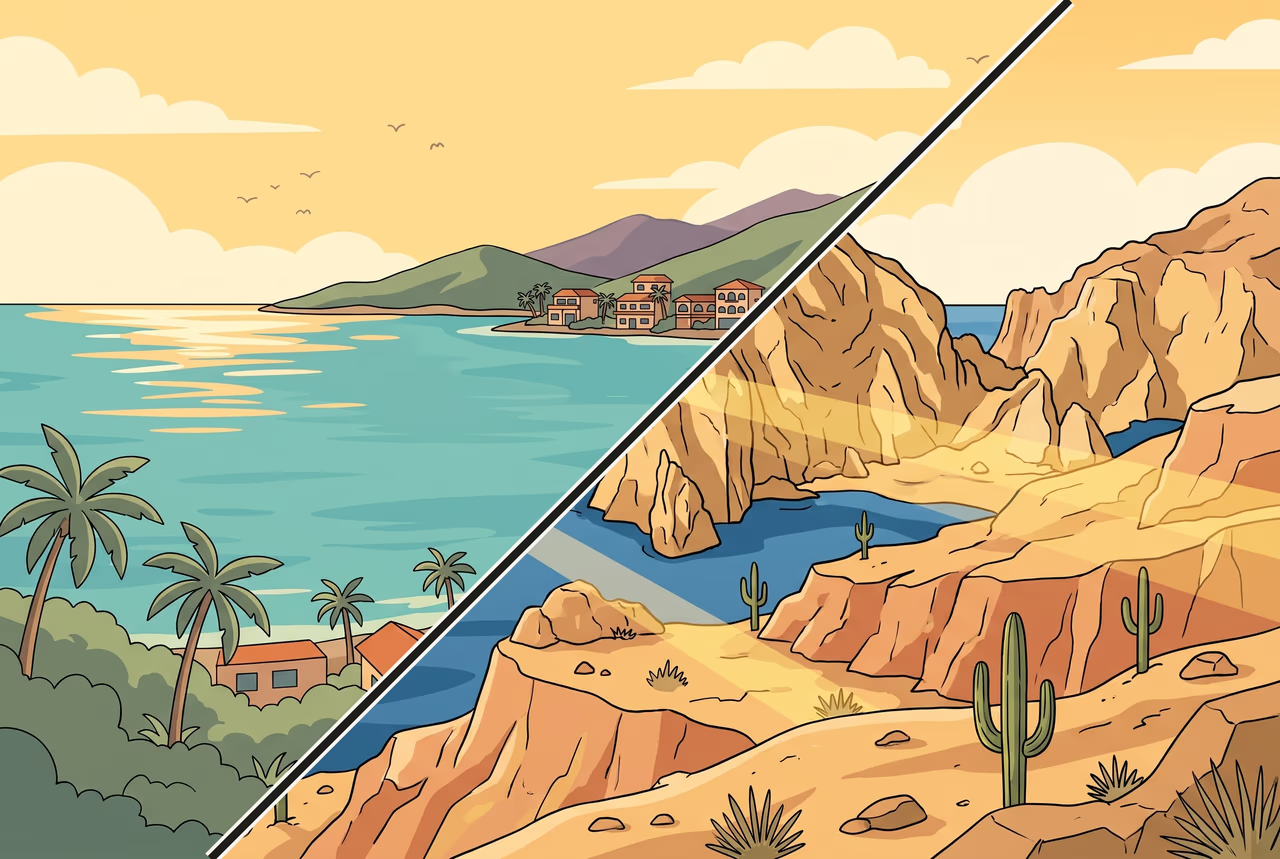
Puerto Vallarta vs Cabo is one of the first comparisons most buyers run before deciding where on Mexico's Pacific coast to put their money, and the answer they are usually given is thin: Cabo is fancier, Vallarta is friendlier, pick a mood. That is not much to buy a property on. The more useful version looks at the two markets on the terms a purchase actually turns on, market maturity, price, the real rental math, climate, and who each place is built for. Below is that comparison, with our Puerto Vallarta figures drawn from our own MLS and the Los Cabos figures labeled as third-party estimates, so you can see where the two genuinely diverge and where they are closer than the reputations suggest.
The short answer
- Cabo is the more mature, luxury-weighted market. Puerto Vallarta is the wider mid-market, with far more inventory across price bands and a much lower entry point.
- The real gap is the typical ticket, not the price per meter. Per-meter estimates for Cabo vary widely by source, so they are a shaky basis for comparison. What is solid is the median ticket: Cabo's stock skews larger and more luxury, so its median price sits far higher.
- The rental math differs. Cabo posts higher nightly rates, but a higher purchase price and higher carrying costs compress the net yield relative to the headline.
- Climate is the clearest hard difference. Cabo is desert, Puerto Vallarta is tropical. That one fact sorts a lot of buyers on its own.
- Ownership works the same way in both. Both sit in Mexico's coastal restricted zone, so both use the same bank-trust mechanism. The real differences are state-level taxes, not the structure.
Market maturity and size
Los Cabos is the more mature and more luxury-driven of the two. Third-party 2025 reports put it at roughly 1.5 to 1.6 billion US dollars in total sales across about 1,800 properties, an average sale price near 850,000 USD, and a luxury segment that accounts for the large majority, on the order of 77 percent, of dollar volume. San Jose del Cabo is the dominant luxury sub-market. The honest way to read that is not "Cabo is bigger" but "Cabo is weighted toward the top." It is a resort-and-branded-residence market first, a mid-market second.
Puerto Vallarta is broader and deeper across price bands, and through 2025 and into 2026 it has tilted toward the buyer. Third-party reports cite about 1,000 sales in the first seven months of 2025 across the two municipalities, totaling roughly 513 million USD, which annualizes on the order of 800 to 900 million, while inventory rose 50 to 100 percent or more and the market shifted toward buyers. Our own MLS shows close to 3,920 active listings across the wider Banderas Bay area, about 2,680 of them condos. The picture that produces is a market with real depth under 500,000 USD, not a thin band of trophy properties.
A note on the figures and geography
Puerto Vallarta numbers here come from our own MLS feed (public_listings, aggregated 24 July 2026); Los Cabos numbers are third-party estimates from market reports and vary widely by source. The two are not line-for-line comparable, partly because each metro is defined differently: our roughly 3,920-listing count covers the broader Bahia de Banderas area, not a single municipality, and Cabo reports sometimes count only one sub-market. Every price below is a range for orientation, not a quote. Per-square-meter figures converted from pesos assume roughly 18 to 19 MXN to the dollar and are approximate.
Prices: the ticket gap, not the price per meter
Start with price per meter, but treat it carefully. Our MLS puts Puerto Vallarta condos at a median near 4,130 USD per square meter, about 385 USD per square foot, with the middle half of the market running roughly 3,240 to 5,460 per square meter, about 300 to 510 per square foot. Third-party per-meter figures for Cabo vary widely by source: some cluster near 4,000 per square meter, about 370 per square foot (with prime marina and beachfront running roughly 3,300 to 6,000 per square meter, about 300 to 560 per square foot), while others put the typical Cabo condo closer to 2,360 per square meter. That spread is too wide to hang a conclusion on, so per-meter is a shaky basis for calling the two markets near-twins.
They are not, because the typical unit is different. Where the two diverge most is the entry point and the median ticket.
| Figures in USD | Puerto Vallarta (our MLS) | Los Cabos (third-party estimates) |
|---|---|---|
| Condo per m2, median | $4,130 ($385/sq ft) | $4,000 ($370/sq ft) |
| Condo per m2, typical range | $3,240 to $5,460 | $3,300 to $6,000 (prime) |
| Condo median list price | $460K | skews toward $900K (luxury-heavy) |
| Comfortable condo entry | $300K+ (25th pct $323K) | $190K to $380K (studio / 1BR) |
| Bottom-decile entry, all active stock | $196K | sub-$100K is thin |
The Cabo median near 900,000 USD is a luxury-skewed figure, not an entry point, which is exactly why it has to be paired with a range. A comfortable studio or one-bedroom in Cabo still exists in the 190,000 to 380,000 range, but the stock thins out fast below that. Puerto Vallarta's condo median list sits near 460,000 USD, a comfortable entry runs from about 300,000, and the bottom decile of all active stock is near 196,000. Whatever the per-meter estimate, the cost to get in the door is materially different, because the unit mix differs. That is the single most important number in the whole comparison for a budget-conscious buyer.
The honest headline is not that one market beats the other. It is that they are built for different buyers.
Rental yield: read the net, not the headline
Both markets can produce rental income, and in both a rental is a small business rather than a passive check. The headline numbers favor Cabo; the net numbers close the gap.
Puerto Vallarta gross yields are commonly cited in the 6 to 10 percent range, with well-placed units reaching 8 to 11 percent, and net yields more like 4 to 6 percent after costs. Annual occupancy tends to run about 59 to 65 percent, with 90-percent-plus peaks from December through April and sub-30-percent lows in September and October. Cabo carries some of the highest nightly rates in Mexico: premium, well-run units command roughly 295 to 390 USD a night, though the market-wide median is well below that. Occupancy swings seasonally from about 35 to 70 percent, and operating costs run higher: villa upkeep, pools, gardens, HOA dues, and management all take a larger bite, on top of a higher purchase price. A higher gross on a bigger, more expensive asset with heavier running costs does not automatically win on net. Always price a rental on the net, after those costs, not on the nightly rate a listing quotes.
Climate: desert versus tropical
This is the clearest hard difference between the two, and for a lot of buyers it settles the question before price ever comes up.
Cabo is desert. It is drier and less humid, with cool dry winters and very hot summers that climb into the mid-90s F (mid-30s C), peaking in late summer, little rain, and an arid, cactus-and-rock landscape that people either love for its starkness or find too bare. Puerto Vallarta is tropical: lush and green, with warmer, humid summers and a June-to-October rainy season that mostly arrives as afternoon showers, mild winters around 77 to 82 F, roughly 25 to 28 C, and warm bay water you can swim in. Both share the same December-to-April high season, which is when both are at their best. One situational note worth knowing: many of Cabo's Pacific-side beaches have strong currents and are not safe for swimming, while Puerto Vallarta's calmer bay generally is. Neither climate is better in the abstract. They just suit different people.
Lifestyle and vibe
Cabo reads as a purpose-built resort destination. It has a strongly American and international feel, curated luxury, villas, golf, and renowned sportfishing, with the Cabo San Lucas nightlife on one end and the quieter, arts-leaning San Jose del Cabo on the other. It is polished, and everyday cost of living runs higher to match.
Puerto Vallarta reads as a real, walkable Mexican city that happens to welcome tourists well. Old Town and the Zona Romantica are genuinely lived-in neighborhoods, there is a large, long-settled expat community and a notably strong LGBTQ+ community, the digital-nomad infrastructure is solid, there is a deeper long-term rental market, and everyday costs sit lower. One is a destination you visit and can also own in; the other is a city you can actually live in year-round. Both are valid. They are just not the same product.
Owning as a foreigner: essentially the same mechanism
Here is the finding that surprises people who expect the two to differ: on ownership, they are essentially identical. Both Puerto Vallarta and Los Cabos sit inside Mexico's coastal restricted zone, the strip within 50 km of the shoreline, so a foreign buyer in either place uses the same mechanism, a bank trust called a fideicomiso that gives you full beneficial rights to use, rent, sell, and inherit the property, or a Mexican corporation in certain cases. Cited fideicomiso costs run roughly 2,000 to 3,000 USD to set up and about 500 to 1,000 USD a year, though those are ranges to confirm with your notario. The real differences between the two are at the state level, predial (property tax) and transfer-tax rates set by Baja California Sur versus Jalisco and Nayarit, not the ownership structure itself. Treat this as an explainer, not advice: the mechanism is routine in both markets, and the specifics of your own transaction and tax position belong with a notario and a Mexican accountant.
Getting there
Access is close to a tie, and both markets are well served. Each has an international airport with heavy US and Canada service and plenty of nonstop North American routes, so neither is hard to reach from most major departure cities, and neither one wins the comparison on connectivity. If you are flying back and forth regularly, both work.
Who each one suits
Strip away the marketing and the choice comes down to fit.
Cabo suits the luxury or lock-and-leave buyer who wants a villa or a branded resort residence, is drawn to bold desert scenery, values golf and marina life, is chasing the high nightly rates, and is comfortable carrying a higher ticket and higher running costs.
Puerto Vallarta suits the buyer who wants a lower entry point, walkable urban authenticity, a real year-round community rather than a seasonal resort, the widest range of inventory across price bands, an LGBTQ+-friendly setting, and value-focused everyday living.
One more honest guardrail, because it comes up. Third-party sources point to strong past appreciation in Cabo, cited anywhere from 50 to 108 percent over five years, and to Puerto Vallarta moderating recently, with modest condo softening and forecasts in the low-single-digit to mid-single-digit range. Read those only as backward-looking context. We do not promise future appreciation or the right moment to buy, in either market. The durable case for buying on this coast is supply, demand, clear ownership, and lifestyle, the things that hold whatever the next cycle does.
The bottom line
Puerto Vallarta versus Cabo is not really a contest between a better market and a worse one. Cabo is the mature, luxury-weighted resort with a higher ticket and higher carrying costs. Puerto Vallarta is the deeper, wider mid-market with a materially lower entry point, a real year-round city around it, and thousands of listings across price bands. If your budget and your use-case point at a villa and a resort lifestyle, Cabo may be the honest answer. If they point at value, walkability, community, and range, Puerto Vallarta usually is.
If Puerto Vallarta is the side of the comparison that fits, start with the search. It pulls the shared local MLS, close to 3,920 listings across the bay, priced in the currency you budget in. If you would rather begin by neighborhood, the walkable Romantic Zone is the in-town option, while Marina Vallarta trades density for space and water. Tell us your budget and how you plan to use the property, and we will give you a grounded read on where the fundamentals actually fit, not a sales pitch for one coast over the other.
To see the inventory behind these numbers, browse Puerto Vallarta real estate by area, from Marina Vallarta to the South Shore.