BlogBuyer guides
Puerto Vallarta vs Cancun for Buyers: Prices, Safety, Rental Yield and Weather
A side-by-side for a buyer, not a tourist: market maturity, price levels, rental-yield reality, weather risk, and who each coast actually suits.
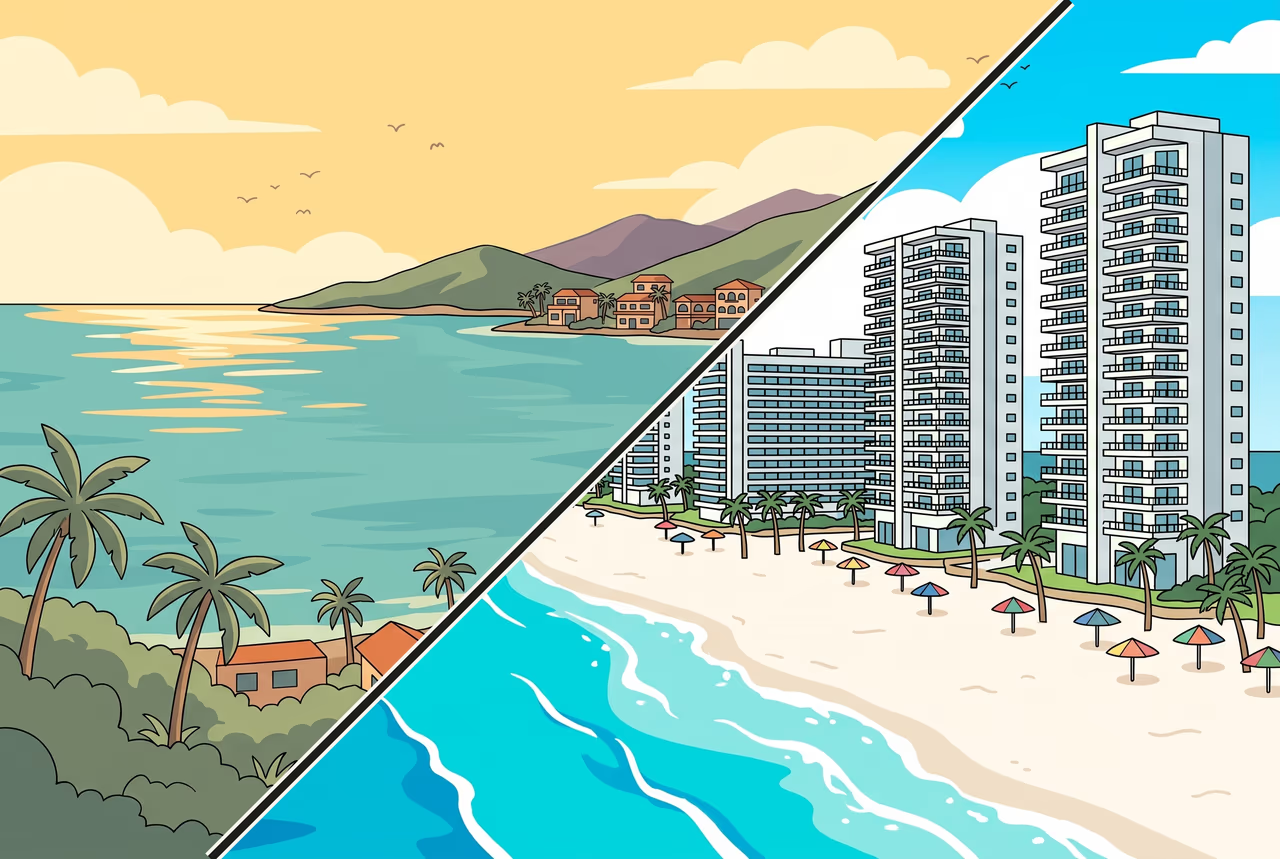
If you are weighing Puerto Vallarta vs Cancun, almost everything written on the subject is aimed at a two-week vacation, not a purchase. A buyer needs different answers: how deep and liquid each market is, what a square meter actually costs, whether the rental math holds up, and which set of trade-offs, on weather, lifestyle, and local rules, you are comfortable owning for years. Both are real, established markets with large foreign-buyer communities, and neither is a mistake. They simply suit different buyers, and the honest way to choose is to line them up feature by feature.
The short answer
- Scale vs momentum. Cancun is the far larger tourism engine, its airport moving roughly three to four times Puerto Vallarta's passenger volume, but 2025 momentum favored Vallarta, which set records while Cancun's arrivals softened.
- Price. Cancun offers cheaper inland and downtown entry; Puerto Vallarta's core commands a premium per square meter. Micro-location matters more than either city's headline average.
- Weather risk. Cancun sits in the Atlantic hurricane belt and gets seasonal sargassum on its beaches. Puerto Vallarta, on the Pacific inside a sheltered bay, gets neither.
- Fit. Cancun suits buyers who want Caribbean beaches and a big cosmopolitan hub. Puerto Vallarta suits buyers who want a walkable town to live in, with lower weather exposure.
A note on these figures
The Puerto Vallarta price figures below come from our own Banderas Bay MLS feed of roughly 3,900 active listings, priced in dollars and pesos. The Cancun figures are third-party data, and we flag them as such: Cancun is outside our market, so we do not have first-party numbers for it and will not imply authority we lack. Every number here is a range for orientation, not a quote, and all dollar figures move with the peso-to-dollar exchange rate.
Market maturity: scale versus momentum
The biggest structural difference is what each city is. Cancun is a purpose-built resort city, planned by the government tourism agency around 1970 on what was close to empty coast. It grew into one of the largest tourism engines in the Americas. Cancun International handled on the order of 24 to 29 million passengers across 2025, against roughly 6.9 million for Puerto Vallarta International, so Cancun's air volume is something like three to four times Vallarta's. That scale brings deeper hotel infrastructure, more direct flights, and a larger visitor pool feeding rentals.
Puerto Vallarta grew the opposite way, as an organic Pacific town that expanded around an existing community. Both are mature, liquid real-estate markets with long-established foreign-buyer bases, so neither is a thin or risky place to own. What diverged in 2025 was momentum. Puerto Vallarta set record tourism and passenger numbers and kept growing, while Cancun's international arrivals softened, with US visitors down roughly 5 to 7 percent in the first half of the year. Read this as scale versus momentum, not winner versus loser. Cancun is bigger; Vallarta was, in the most recent data, growing faster.
What a square meter costs
Prices are usually quoted per square meter, and here the two cities have swapped the intuition most buyers arrive with. Current 2025 third-party data puts Puerto Vallarta's average around $3,800 USD per square meter and Cancun's residential average nearer $2,400, with a typical Cancun range of about $2,000 to $4,000. Our own inventory corroborates the Vallarta figure: across active Banderas Bay listings with a valid price and area, the median is roughly $3,900 USD per square meter, with a middle-half band of about $2,800 to $5,050.
The averages hide most of the story, because micro-location dominates both markets. Here is the rough shape by sub-area:
| Location | Typical price (USD/m2) |
|---|---|
| Cancun suburban | $1,800 - $2,500 |
| Cancun downtown | $2,000 - $3,000 |
| Cancun hotel zone / beachfront | $3,000 - $4,500 |
| Puerto Vallarta outer neighborhoods | ~$2,200 or below |
| Puerto Vallarta core (Zona Romantica, Marina Vallarta) | ~$5,000 - $8,500 |
Puerto Vallarta's core zones, walkable Zona Romantica and the yacht-basin condos of Marina Vallarta, are quoted around 80,000 to 145,000 pesos per square meter, which lands near $5,000 to $8,500 depending on the exchange rate. Cancun's downtown and inland neighborhoods are meaningfully cheaper to enter, but its hotel-zone beachfront is not cheap. One caveat on sourcing: not every dataset agrees, and a minority put Cancun above Vallarta. The current weight of 2025 data, and our own feed, point the way we have described, though the specific block matters more than any citywide number.
What a whole condo costs
Translated into whole-unit prices: in Cancun, a typical two-bedroom, two-bath condo runs roughly $150,000 to $350,000 USD inland and $250,000 to $600,000 for hotel-zone or beachfront, as an illustration, not quotes. In Puerto Vallarta, our active inventory shows a median list price around $460,000 USD, with a middle-half band of roughly $325,000 to $650,000 across the full Banderas Bay MLS.
The practical takeaway: a sub-$300,000 entry is easier to find inland in Cancun, while Puerto Vallarta's median condo sits in the mid-$400,000s. That reflects where the inventory concentrates, much of it walkable and close to the water, rather than Vallarta being expensive across the board. As always, treat these as ranges that move with the unit, the zone, and the peso.
Rental yield, honestly
Both markets are commonly cited at 6 to 12 percent gross annual yield for well-run short-term rentals. Puerto Vallarta sources tend to cluster at 6 to 10 percent gross, and 4 to 6 percent net once costs come out, with the two-bedroom condo as the reliable sweet spot. Long-term rentals net far less, on the order of 2 to 3 percent, in exchange for less work.
Occupancy and nightly-rate figures vary a great deal by data provider, which is worth knowing before you build a spreadsheet on one source. Puerto Vallarta Airbnb occupancy is quoted anywhere from about 38 to 59 percent, with daily rates around $140 to $200. Cancun is quoted near 40 percent annual occupancy at about $117 per night by one source, and 70 to 90 percent in peak season by others.
The honest read is the same one we give in Vallarta regardless of the comparison. These are gross yields, before management, vacancy, furnishing, taxes, and HOA dues. A short-term rental is a small business, not a passive check. Do not treat any single quoted yield as a promise.
Weather and hurricane risk
This is where the two coasts clearly part ways, and for many buyers it is decisive. Cancun is Caribbean and tropical, averaging around 27 degrees Celsius, humid nearly year-round, with a very dry December to April season and the white-sand, turquoise water it is famous for. Puerto Vallarta is Pacific, tucked inside Banderas Bay and backed by the Sierra Madre, averaging around 25 degrees with a drier winter feel and a defined rainy season from roughly May or June through October.
The load-bearing difference is hurricane exposure. Cancun sits squarely in the Atlantic hurricane belt and is far more exposed to a direct hit. Puerto Vallarta is comparatively sheltered by the bay and the mountains behind it. The figures cited most often, a direct hit roughly every seven years for Cancun against roughly every 35 years for Vallarta, come from tourism and community sources, so treat them as directional rather than precise. The direction, though, is not in dispute: the Pacific bay carries materially less hurricane risk than the Caribbean coast, which affects insurance, off-season rental reliability, and how often you worry in September.
Sargassum and beach quality
Sargassum is the other weather-adjacent factor, and it is concrete enough to change how a beach reads. It is a seaweed that originates in the Atlantic and washes ashore seasonally along the Caribbean coast: Cancun, the Riviera Maya, Tulum, Cozumel. It arrives in mats and costs real money to clear. 2025 was flagged as a possible record year, and the state of Quintana Roo collected more than 40,000 metric tons in 2024 alone, with monitors expecting more.
Because sargassum is an Atlantic phenomenon, the Pacific does not receive these blooms, so Puerto Vallarta's beaches are not subject to them. That point follows from the geography rather than from any Vallarta-specific study, so we state it as what it is. For a buyer weighing rental appeal and personal use, it is a difference worth pricing in: beach usability and cleanup cost are simply not the same on the two coasts.
The honest comparison is not which coast wins. It is which set of trade-offs you would rather own for the next ten years.
Lifestyle and vibe: who each city suits
Puerto Vallarta reads as an organic, walkable town. Cobblestone streets run through Old Town and the Zona Romantica and up into Centro, and a long-established, famously LGBTQ-welcoming expat community gives it a settled, community-focused pace. It feels like an authentic Mexican town where many owners live without a car, walking to the market, the Malecon, and dinner. That walkability is also a demand driver, which is part of why its rental market holds up.
Cancun is the resort-and-hotel-zone model at scale: more spread out, more cosmopolitan, amenity-rich, with bigger nightlife and the Caribbean beaches doing the heavy lifting. You generally taxi or drive between things, and it feels less like a single walkable neighborhood and more like a large tourism city with distinct districts, next door to the Riviera Maya.
So who does each suit? Cancun fits a buyer who wants Caribbean beaches, a larger cosmopolitan hub, and a bigger pool of lower-priced inland units to enter through. Puerto Vallarta fits a buyer who wants to live in or immerse in a walkable community, in a durable rental town, with lower weather risk. If the plan is to use the property often and be part of a place rather than a resort strip, that tilts toward Vallarta.
Foreign ownership: same mechanism, different state rules
One thing that is not a differentiator is the ownership mechanism. Both cities sit inside Mexico's constitutional restricted zone, the band within 50 kilometers of the coast, so a foreign buyer uses the same vehicle in each: a bank trust, the fideicomiso, or a Mexican corporation in certain cases. Setup is commonly cited around $2,000 to $3,000 USD, with annual trust fees near $500 to $1,000, and the 50-year term is renewable. Those are typical figures, not a quote; the notario handling your transaction gives the real ones.
What does differ is state-level short-term-rental regulation, and it is the regime, not the tax rate, that separates them. Both states now levy a lodging tax (ISH) in the same 4 to 5 percent band: Jalisco raised its ISH to 4 percent in 2025 and 5 percent in 2026, up from the former 3 percent, and Quintana Roo sits in a comparable 3 to 5 percent range. The real difference is administrative weight. In Jalisco, where Puerto Vallarta sits, the ISH is a single state tax that Airbnb calculates and remits on your behalf, on top of a municipal business license, and that is essentially the whole apparatus. Quintana Roo, where Cancun sits, tightened its rules under a 2025 tourism law into a newer multi-layer regime: municipal-level licensing, a state tourism registry (Retur-Q), its own lodging tax, and fines cited as high as 100,000 pesos for operating unregistered. This is explainer, not advice, and it is not a reason to rule Cancun out; it is a reason to confirm the current rules with a local notario and a Mexican accountant before you count on rental income. Never assume an individual tax or licensing outcome from a blog.
So, which one?
Line the two up and the pattern is clear rather than close. Cancun is the bigger engine, with cheaper inland entry, Caribbean beaches, and a cosmopolitan scale some buyers specifically want, alongside more weather exposure, seasonal sargassum, and a heavier new short-term-rental rulebook. Puerto Vallarta costs more per meter in its core, but pairs a genuinely walkable town you can live in with lower hurricane risk, no Atlantic sargassum, a simpler rental regime, and, in the most recent data, stronger momentum.
For a buyer who is choosing a place to spend real time, not just to park money near a beach, those are the trade-offs that tend to age well. That is our read, from a market we know first-hand rather than one we watch from a distance.
If you want to test it against your own plan, tell us your budget and how you intend to use the property, and browse the full Puerto Vallarta and Banderas Bay listings to see where the numbers land. We will give you an honest picture of what your budget buys here, and where it would buy more somewhere else.
If Puerto Vallarta is the side that fits, browse Puerto Vallarta real estate by area to see what the numbers above look like on the ground.