Executive Summary
Between 2020 and 2025, closed sales across the 14 most active zones of Banderas Bay rose 57% in unit count and 141% in dollar volume. The volume-weighted average sale price climbed from $358,000 to $549,000, a 53% increase in six years.
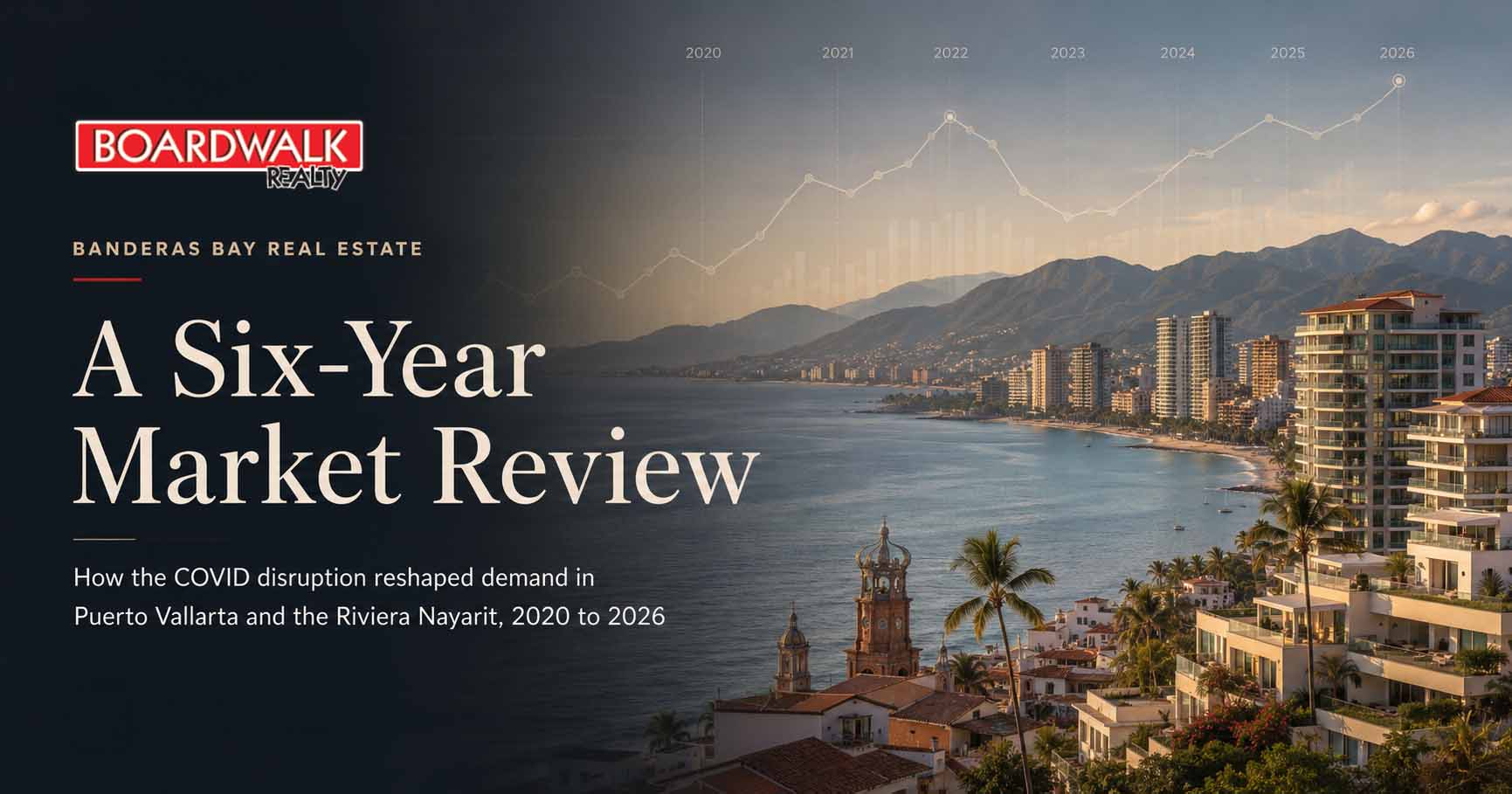
That headline tells only the broadest version of the story. The path was not a straight line. The COVID disruption of 2020 was followed by an explosive rebound in 2021 and 2022, a meaningful correction across 2023 and 2024, a renewed surge in 2025, and the first measurable signs of softening in the opening months of 2026. This paper walks through each phase, what drove it, and where the data points the market today.
Five key findings
- 2020 closed with 890 units sold and $319M in dollar volume. The COVID floor, not a crash.
- The post-COVID rebound peaked in 2022 at 1,995 units and $798M in volume, more than double 2020 on both measures.
- A correction in 2023 and 2024 cut transaction counts back near 2020 levels even as average prices kept rising. Fewer deals, higher tickets.
- 2025 produced a second wave of growth: 1,401 units and $770M in volume, up 31% and 34% respectively over 2024.
- The first four months of 2026 are tracking 29% below the same period of 2025 in units and 19% below in volume. Early evidence that the second wave has paused.
Annual Closed Sales, 14-Zone Total
Units sold per calendar year
Annual Sold Volume, 14-Zone Total
US dollars (millions)
The COVID Year: 2020
By any conventional measure, 2020 should have been a wreck for real estate in a destination market. International travel collapsed, the Mexican peso swung sharply against the US dollar, and the southern border was closed for non-essential trips for much of the year. Yet across the 14 zones of Banderas Bay that this paper tracks, the market did not collapse. It paused.
Total closed sales for 2020 came in at 890 units across $319M in dollar volume. The volume-weighted average sale price held near $358,000, actually higher than several recent prior years thanks to a buyer mix that skewed toward second homes and high-end condos rather than entry-level transactions.
Puerto Vallarta benefited from two structural advantages while much of North America locked down. First, Mexico’s national COVID policy was less restrictive than the United States’ or Canada’s, and the bay’s beach-driven economy reopened earlier than urban markets. Second, the very nature of remote work, newly mainstream by mid-2020, made a beachfront condo with reliable fiber internet look less like a luxury and more like a viable primary residence.
The seeds of the boom that followed were planted in those eight or nine quiet months. Buyers who had visited the bay for years began running the math on relocating. Asset prices in the United States and Canada were climbing fast, padding home equity for would-be second-home owners. And the peso, although volatile, settled at levels that gave US-dollar buyers more purchasing power per dollar than they had seen in years.
Market Overview, Period by Period
All figures below are aggregated across the 14 zones covered in this paper. Units are closed sales; volume is the sum of sale prices in US dollars; average sale price is volume-weighted.
| Period | Units Sold | Sold Volume | Avg Sale Price | Δ% Units (YoY) |
|---|---|---|---|---|
| 2020 | 890 | $318.9M | $358,000 | n/a |
| 2021 | 1,761 | $676.9M | $384,000 | +97.9% |
| 2022 | 1,995 | $798.2M | $400,000 | +13.3% |
| 2023 | 1,186 | $571.9M | $482,000 | -40.6% |
| 2024 | 1,072 | $575.8M | $537,000 | -9.6% |
| 2025 | 1,401 | $769.7M | $549,000 | +30.7% |
| 2025 YTD | 531 | $283.1M | $533,000 | n/a |
| 2026 YTD | 378 | $228.1M | $603,000 | -28.8% |
YTD comparisons are January 1 through April 30 only. They are not directly comparable to full-year totals.
The Post-COVID Rebound: 2021 to 2022
The transition from 2020 to 2021 produced one of the sharpest demand surges Banderas Bay has ever recorded. Closed sales nearly doubled, from 890 units to 1,761, a 98% increase. Volume jumped 112%, from $319M to $677M. And 2022 pushed further still: 1,995 units and $798M in volume, the highest annual totals in the period this paper covers.
Four forces converged to produce the surge:
- Remote work made Puerto Vallarta viable as a primary residence for thousands of US and Canadian professionals who could not previously have lived this far from corporate headquarters.
- North American mortgage rates were at multi-decade lows through 2021, freeing capital for second-home purchases and pulling forward demand.
- Strong North American equity markets through 2021 boosted home equity in source markets, which translated directly into all-cash bay-area purchases.
- Mexico’s relatively open economy made it one of the few accessible international destinations for North Americans, accelerating the lifestyle-migration trend that had been building for a decade.
The condo market absorbed most of the new demand. Condo unit sales went from 702 in 2020 to 1,382 in 2021 (+97%) and 1,667 in 2022 (+19% over 2021). Houses followed a similar pattern with a smaller base. Land was the most volatile category, with its peak unit year landing in 2021 at 78 sales across the tracked zones.
Within the bay, the rebound was uneven. Hotel Zone condos, which had recorded 77 closed sales in 2020, exploded to 257 in 2021, more than tripling in a single year, driven primarily by short-term-rental investment as travelers returned to the bay in force. Marina condos went from 25 sales in 2020 to 87 in 2021 and 103 in 2022. Centro North and Centro South saw similar surges. The zones that did best were those with the most inventory ready to absorb sudden new-buyer demand.
By the end of 2022, every indicator pointed up. Active listings, new listings, and closed sales were all at multi-year highs. Average prices had climbed only modestly ($358,000 to $400,000 over two years), suggesting the surge was being absorbed by supply rather than purely bid up. That balance would not last.
The Correction: 2023 to 2024
The forces that drove the rebound began to reverse in 2023. The US Federal Reserve had begun raising rates aggressively in mid-2022, and by 2023 those rates were biting. North American mortgage rates that had been below 3% in 2021 were above 7% in 2023. Cash-equivalent yields above 5% in the United States gave investors a viable alternative to vacation-home cap rates. And the Mexican peso strengthened sharply, reducing US-dollar buyers’ purchasing power by roughly 15% over twelve months.
The result was a textbook correction. 2023 closed sales fell to 1,186 units, down 41% from 2022’s peak. Dollar volume dropped from $798M to $572M, a 28% decline. The cuts were not evenly distributed: Hotel Zone condo sales, which had spiked to 257 in 2021, fell to 308 in 2022, then collapsed to 80 in 2023, a clear sign that speculative short-term-rental investment had cooled as financing got expensive and STR yields compressed.
2024 extended the slowdown but at a much gentler pace. Total closed sales were 1,072, just 10% below 2023. The market had found a level.
What is worth noting is that average sale prices did not fall during the correction. The volume-weighted average sale price went from $400,000 in 2022 to $482,000 in 2023 to $537,000 in 2024, a 34% increase across the trough of the cycle. The pattern is one analysts often see early in cooling markets: transaction counts fall first, the mid-market thins out, and the deals that close skew toward higher-end properties where buyers are less rate-sensitive. The average looks healthier than the underlying market actually is.
On the ground, days on market lengthened. Negotiation returned. The cash bidding wars of 2021 and 2022 disappeared. But the luxury segment held firm, and certain established zones (South Shore, Punta de Mita, and San Pancho) saw very little change in dollar volume even as transaction counts moved around them.
Volume-Weighted Average Sale Price
14-zone total, US dollars (thousands)
The Renewed Strength of 2025
By late 2024, several of the headwinds of 2023 had eased. The US Federal Reserve had begun cutting rates. North American mortgage rates settled into the 6% range. The Mexican peso weakened slightly against the dollar, restoring some of the purchasing power that had been lost. Mexico’s post-election political environment remained stable. And the buyers who had stepped to the sidelines in 2023 and 2024 had been watching the bay for two years.
2025 closed with 1,401 unit sales and $770M in dollar volume, up 31% and 34% respectively over 2024. The volume-weighted average sale price ticked up to $549,000, only a modest gain on top of the elevated 2024 number, suggesting that the recovery in volume came from a broader buyer base rather than continued tightening at the high end.
By property type, the recovery was concentrated in condos and houses:
- Condo units: 851 in 2024 → 1,142 in 2025 (+34%)
- House units: 168 in 2024 → 210 in 2025 (+25%)
- Land units: 53 in 2024 → 49 in 2025 (-8%). The only segment that did not participate.
Within the bay, the leadership reshuffled. Marina condos surged back, recording 135 closed sales, the zone’s strongest year in our six-year window. Centro North condos hit 133 sales, more than three times the 2020 figure. Hotel Zone condos rebounded to 106 sales after the 2023 collapse. And the established luxury markets (South Shore, Punta de Mita, and San Pancho) continued to absorb high-ticket transactions without drama.
2026 YTD: The Second Wave Pauses
Through April 30 of 2026, the bay closed 378 unit sales across $228M in volume. Compared with the same period of 2025, that is a 29% decline in units and a 19% decline in volume. The volume-weighted average sale price climbed to $603,000, a 13% gain over 2025 YTD.
Three readings of this data are reasonable, and it is too early to choose between them. The market may be entering a soft landing in which transaction counts ease modestly while prices hold, similar to the 2023-2024 pattern but at higher base prices. It may be the front end of a deeper correction as accumulated price gains catch up with buyer affordability. Or it may be a January-through-April seasonal anomaly that will reverse in the second half of the year as inventory turns over and the high-volume months approach.
What the four months of data do tell us is which property segments are softening fastest. Condo units are down 33%, houses are down 9%, and land is up 40% from a very small base. The mid-market is thinning faster than the luxury segment, which is consistent with a typical late-cycle pattern but does not yet rise to the level of a true correction.
The next two quarters will resolve the question.
2025 Zone Leaderboard by Sold Volume
All property types combined, US dollars (millions)
Zone-Level Performance: 2025 Leaderboard
The fourteen zones below are the active sub-markets of Banderas Bay that this paper tracks. Sorted by 2025 sold volume across all three property types:
| Rank | Zone | Units Sold | Sold Volume | Avg Sale Price (vol-wtd) |
|---|---|---|---|---|
| 1 | South Shore | 115 | $100.6M | $874,000 |
| 2 | Centro South | 179 | $95.1M | $531,000 |
| 3 | Nuevo Vallarta West | 146 | $86.7M | $594,000 |
| 4 | Marina | 138 | $72.0M | $522,000 |
| 5 | Centro North | 162 | $68.8M | $425,000 |
| 6 | Bucerias | 137 | $66.1M | $482,000 |
| 7 | Hotel Zone | 106 | $59.5M | $561,000 |
| 8 | Francisco Villa West | 166 | $56.0M | $337,000 |
| 9 | La Cruz de Huanacaxtle | 75 | $51.1M | $681,000 |
| 10 | Sayulita | 40 | $32.6M | $814,000 |
| 11 | Flamingos | 46 | $22.4M | $487,000 |
| 12 | San Pancho | 24 | $21.3M | $887,000 |
| 13 | Punta de Mita | 8 | $19.3M | $2,412,000 |
| 14 | Aramara | 59 | $18.3M | $310,000 |
| 14-zone total | 1,401 | $769.7M | $549,000 |
Volume-weighted average sale price reflects the mix of transactions in each zone, not the price of a typical listing.
Three observations from the 2025 leaderboard:
- South Shore takes the top spot by dollar volume despite only the eighth-highest unit count. The mix in South Shore skews heavily toward seven-figure beachfront condos and houses, so a comparatively small number of transactions translates into outsized dollar flow.
- Centro South, ranked #2 by volume, is the highest-unit-count zone in the bay (179 sales). It functions as the urban core’s transaction engine: broad inventory, broad price range, deep buyer pool.
- Nuevo Vallarta West, at #3, reflects the long-running migration of new-development supply onto the Nayarit side of the bay. It has been a top-five-volume zone every full year in this period.
Looking back six years, Marina is the most dramatic individual growth story: condo unit sales went from 25 in 2020 to 135 in 2025, a fivefold increase. Aramara, which did not register any condo sales in 2020, recorded 45 in 2025. Both reflect new-development supply meeting redirected post-COVID demand.
Property Type: Six-Year Trajectories
The three property types covered here have traveled different paths through the 2020 to 2026 period.
| Type | 2020 | 2021 | 2022 | 2023 | 2024 | 2025 | 6-yr Δ% |
|---|---|---|---|---|---|---|---|
| Condo | 702 | 1,382 | 1,667 | 952 | 851 | 1,142 | +62.7% |
| House | 152 | 301 | 281 | 175 | 168 | 210 | +38.2% |
| Land | 36 | 78 | 47 | 59 | 53 | 49 | +36.1% |
| Total | 890 | 1,761 | 1,995 | 1,186 | 1,072 | 1,401 | +57.4% |
Volume tells a different story than unit count. Across the same period, condo dollar volume grew 140% (from $243M to $584M) and house volume grew 166% (from $64M to $171M). Land volume grew only 26% (from $11.7M to $14.7M) and is the smallest market by an order of magnitude.
Condos
The largest category, the largest absolute growth, and the most rate-sensitive. Condos are the typical entry point for international buyers, the primary STR-investment vehicle, and the asset class most directly affected by US mortgage-rate cycles. The bay’s new-development pipeline is overwhelmingly condo-driven.
Houses
A smaller market in unit count but with faster percentage volume growth than condos over the six-year period. Houses skew higher in average price, particularly in Punta de Mita, San Pancho, La Cruz, and South Shore. The 2025 rebound was meaningful at 25% unit growth, and suggests the segment is more resilient than condos to short-term rate noise.
Land
The most cyclical and the smallest category. A single $3M to $7M transaction in any given year can swing the totals materially, which is why land Δ% numbers look erratic. Sustainable demand for land tracks the pipeline of new development, which itself tracks condo absorption. Land is therefore a leading indicator for the next cycle of new-build supply.
What This Means for Buyers, Sellers, and Investors
For buyers
Inventory is higher and DOM is longer than at any point in this six-year window. The 2025 active-listings count at year-end was approximately 8,685 across the broader MLS, well above the 4,316 active in early 2020. Buyers have negotiating leverage they did not have in 2021 and 2022. The currency-timing question matters more than it did when the peso was structurally weaker. The luxury segment remains seller-leaning; the mid-market is more balanced.
For sellers
Pricing realism matters. The 2024 and 2025 sellers who held firm at 2022 list prices saw their properties sit. The sellers who priced into current market levels closed, often near asking. DOM has stretched but quality listings still move. Investment in professional photography, accurate pricing, and a clean presentation makes a larger difference now than it did at the height of the rebound.
For investors
Short-term-rental yields are still attractive on a global basis but cap rates have compressed meaningfully since 2020. The new-development pipeline in Hotel Zone, Aramara, and parts of Marina will create supply pressure on resale absorption over the next 24 months. The long-term thesis (demographic tailwinds, infrastructure investment, deepening international demand, persistent currency advantage) remains intact, but timing matters more in 2026 than it did in 2021.
Conclusion
Stepping back from the year-by-year detail, the six-year arc tells a clear story. Banderas Bay’s real estate market is fundamentally larger, more liquid, and more international than it was at the start of 2020. Total annual dollar volume is operating at roughly 2.4x the 2020 level even after the 2026 YTD softening. Average prices are 50% higher. New-development supply has filled out, the buyer base has broadened across more source markets, and the institutional and informational infrastructure around the market has matured.
Whether the rest of 2026 brings further cooling, a soft landing, or another rebound, the medium-term direction (driven by demographics, infrastructure, lifestyle migration, and persistent currency dynamics) remains constructive. The months ahead are the most interesting in years. Anyone whose plans depend on this market will want to be watching closely.
The Boardwalk Brief
This report is part of The Boardwalk Brief, our ongoing series on Puerto Vallarta and Riviera Nayarit real estate, written from inside the Banderas Bay market for the people moving through it. Subscribers receive each new Brief as soon as it publishes.
- In-depth market reviews (PDF)
- Zone and neighborhood deep-dives
- New-development tracking across Puerto Vallarta and Riviera Nayarit
- Buyer and seller insights from our 15+ years on the ground
Methodology and sources
Data sourced from FlexMLS via Boardwalk Realty Puerto Vallarta. The fourteen zones tracked in this paper (Aramara, Bucerias, Centro North, Centro South, Flamingos, Francisco Villa West, Hotel Zone, La Cruz de Huanacaxtle, Marina, Nuevo Vallarta West, Punta de Mita, San Pancho, Sayulita, and South Shore) represent the most active sub-markets of Banderas Bay across Puerto Vallarta (Jalisco) and Riviera Nayarit. Property types covered are Condos, Houses, and Land; Commercial, Multi-Family, Fractional, and Business segments are excluded.
Full-year periods (2020 to 2025) reflect closings between January 1 and December 31. YTD periods (2025 YTD, 2026 YTD) reflect closings between January 1 and April 30. YTD figures are not directly comparable to full-year totals.
Information is deemed to be reliable but is not guaranteed. © 2026 MLS and FBS. Prepared by Boardwalk Realty Puerto Vallarta, AMPI, CIPS, CONOCER, NAR.